Mathematics
Calculus
 SimulationUpdatedOct 31
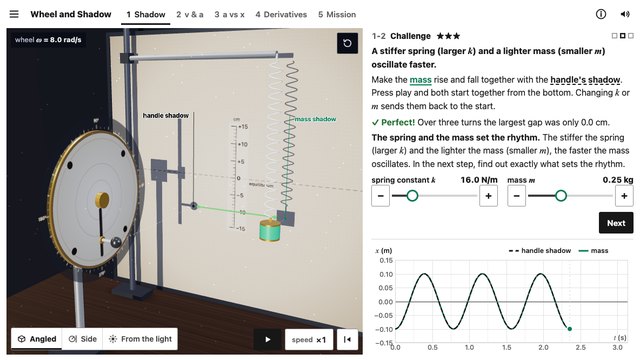
Wheel and Shadow: Simple Harmonic Motion
In a dark lab, parallel light casts the handle of a turning wheel onto the wall. Match a mass on a spring to the bobbing shadow to find ω = √(k/m), check velocity, acceleration and a = −ω²x, then use tangent slopes and a radius-1 circle to see why (sin θ)′ = cos θ and how the chain rule works.
Made with three.js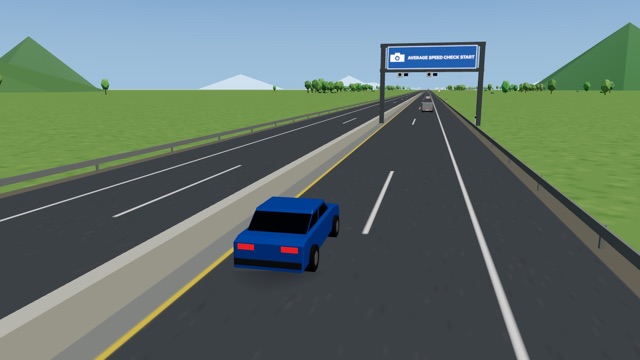 SimulationUpdatedOct 31
Speed Camera Racer
Drive a 10 km average speed check on a straight highway with the speed up and slow down buttons while the position-time and velocity-time graphs are drawn. Use the mean value theorem (a tangent parallel to the line through two points) to see why slowing down only at the cameras still gets a ticket, then paint the area under the velocity graph to find that it equals the distance driven.
Made with three.js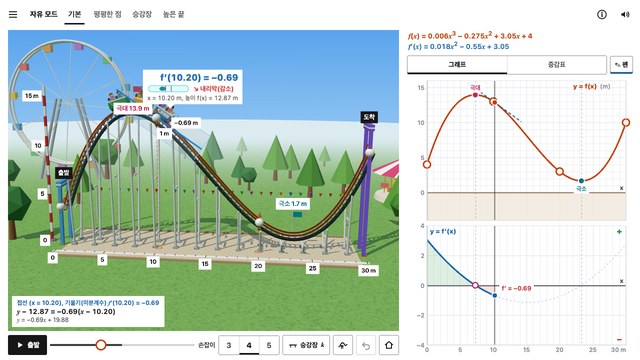 Simulation
Roller Coaster Design
Drag handles to design a polynomial track y = f(x) while the train’s slope gauge measures and plots f′(x). Five missions explore sign charts, local maxima and minima, tangent lines, real roots of f(x) = k, and maximum and minimum values on a closed interval.
Made with three.js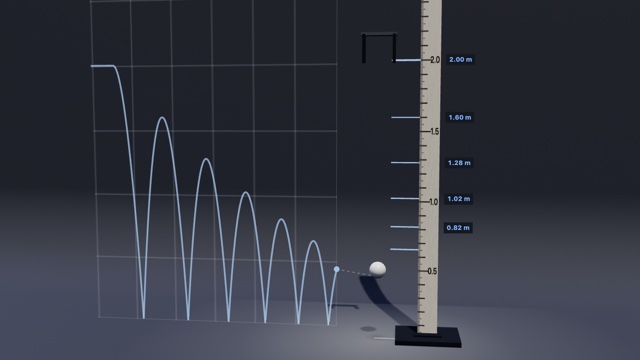 Simulation
The Endless Bounce
Drop balls with different bounce ratios r from a height h and watch the distance h + 2hr + 2hr² + ⋯ of an endlessly bouncing ball pile up as partial sum bars that approach the sum of the series h + 2hr/(1 − r). See that the sum grows as r nears 1, diverges when r = 1, and that the time until the ball stops is also finite, a geometric series with ratio √r.
Made with three.js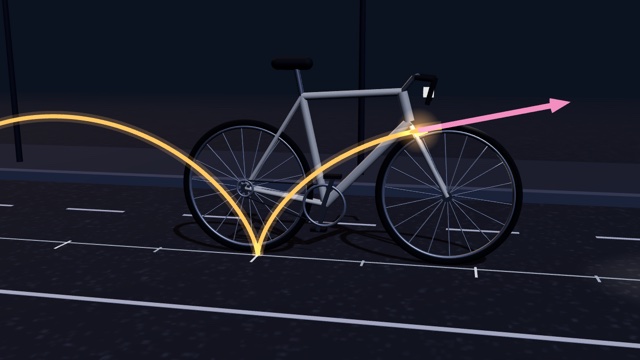 Simulation
A Point on a Bicycle Wheel
Roll a bicycle wheel along a night road, watch the reflector on its rim trace a cycloid, and differentiate with respect to the parameter θ to get the reflector’s velocity and the slope of the tangent. Find that the reflector stops for an instant when it touches the ground (the cusp) and moves at twice the bike’s speed at the top, then compare it with the smooth curve traced by a point on a spoke.
Made with three.js