Physics
Thermal & Statistical Physics
 Simulation
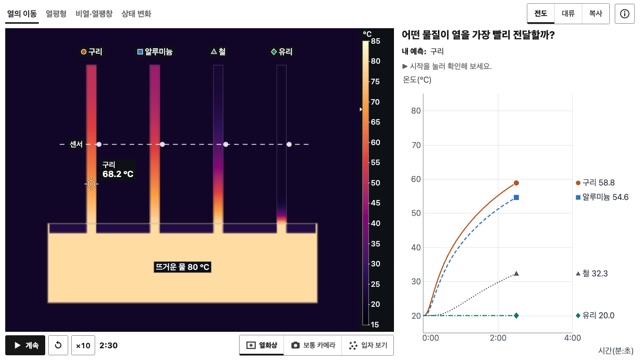
Virtual Thermal Camera: Equilibrium, Specific Heat and Phase Change
Use a virtual thermal camera to watch conduction, convection and radiation, thermal equilibrium, specific heat and expansion, and the heating curve of ice and cooling curve of water. Switch between thermal, visible and particle views of the same calculation, test your prediction and read the time–temperature graph.
Made with HTML · JavaScript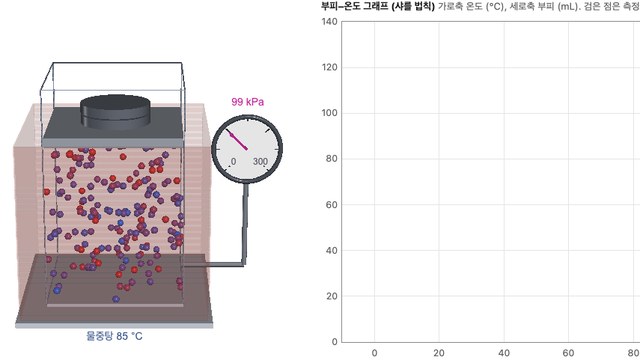 Simulation
Gas Particles and Pressure: Boyle's and Charles's Laws
Measure gas pressure from the pushes of 200 particles hitting the walls, then change the volume with a piston or the water-bath temperature (0–100 °C) and record points to build pressure–volume and volume–temperature graphs. Each point also records how often and how hard the particles hit, for a particle-model explanation.
Made with Web VPython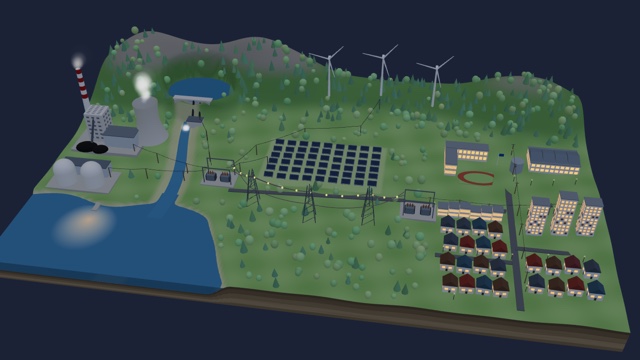 SimulationUpdatedOct 31
Running the Town's Power Grid
In a 3D town with nuclear, coal, hydro, solar and wind plants, set plant output and transmission voltage through one day to keep the lights on. Trace energy conversion and efficiency inside a coal plant, see I = P/V and the I²R loss on the line, and test turns ratios and why a transformer needs AC.
Made with three.js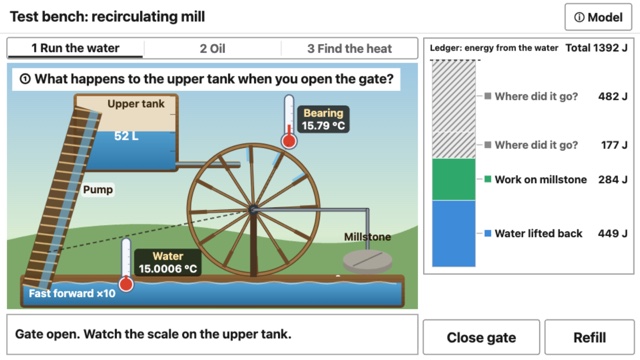 Game
Perpetual Motion Patent Examiner: Judge the Machines That Never Stop
A 20–25 minute story game: as a new patent examiner, run six perpetual motion inventions on a test bench (an overbalanced wheel, a recirculating mill, a magnet ramp, a ship run on ocean heat, a drinking bird and a self-charging electric car), balance each energy ledger, then judge it with an evidence card and a stamp.
Made with RPG Maker MZ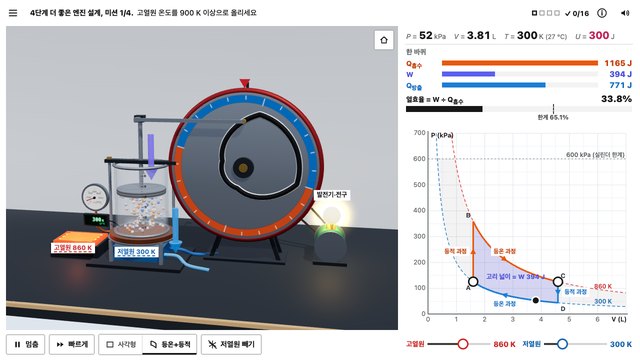 Simulation
Piston Heat Engine
Heat, cool and load a gas in a glass cylinder to see isochoric, isobaric, isothermal and adiabatic processes obey Q = ΔU + W, close the loop into a weight-lifting engine, design a cam-wheel engine to probe the limits of thermal efficiency, and explain irreversible changes with entropy as a count of arrangements.
Made with three.js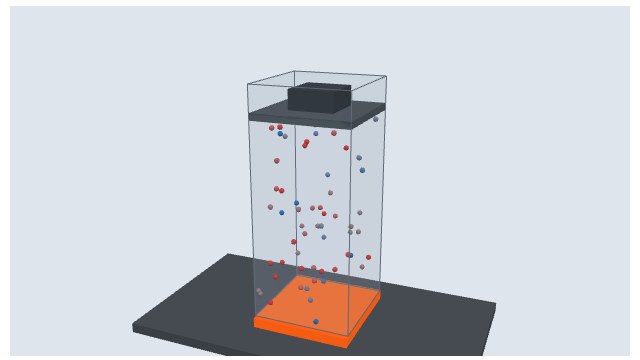 SimulationNewOct 29
Molecule Piston
Watch individual molecules in a cylinder to see that pressure is molecules hitting the walls and temperature is their average kinetic energy. Count, collision by collision, how molecules speed up off an approaching piston in adiabatic compression, gain kinetic energy from a hot plate as heat, and do work pushing the piston, so that Q = ΔU + W appears, then explain irreversible change with free expansion and counting arrangements.
Made with three.js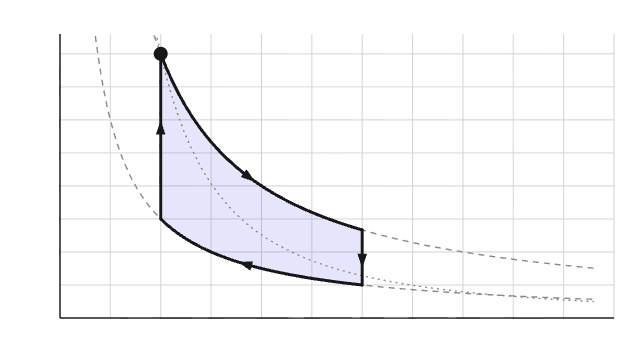 SimulationNewOct 29
P–V Pathfinder
Mark states as points on a P–V graph and read their temperature from isotherms, then drag isochoric, isobaric, isothermal and adiabatic pieces together to see Q, ΔU and W in a table and as areas. Join the same two states by different paths to see that work and heat depend on the path, close cycles to tell a heat engine from a refrigerator, and calculate in the calculation lab.
Made with HTML · JavaScript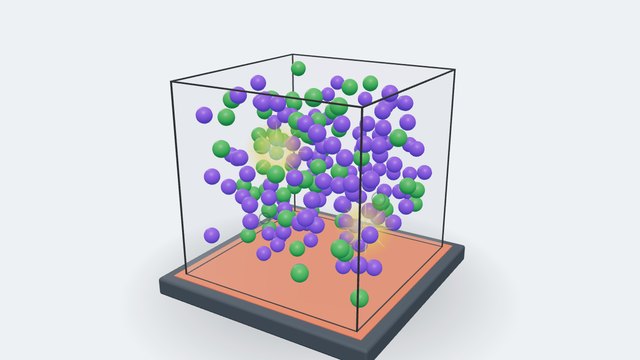 Simulation
Collision Box
Watch effective collisions and the activation energy with particles in a 3D box, and change temperature, concentration and catalyst to see the kinetic energy distribution and the rate graph change together. Find a rate law from runs with different starting concentrations and read half-lives from first-order graphs.
Made with three.js