Physics
Classical Mechanics
 Simulation
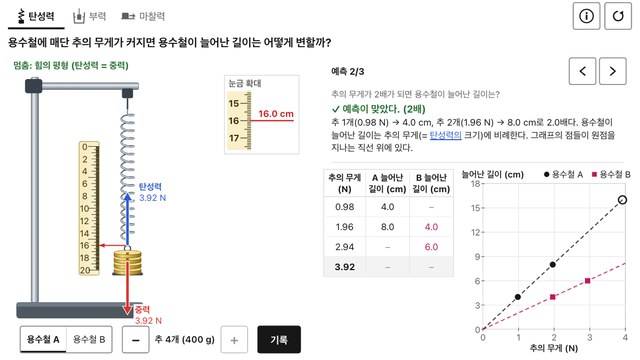
Force Lab: Elastic Force, Buoyancy and Friction
Hang weights on springs and measure the extension, lower an object on a spring scale into water to find the buoyant force, and pull a wooden block to measure the force just before it moves. In each lab you predict first, see the forces as arrows (size and direction), and check with a table or graph.
Made with SceneryStack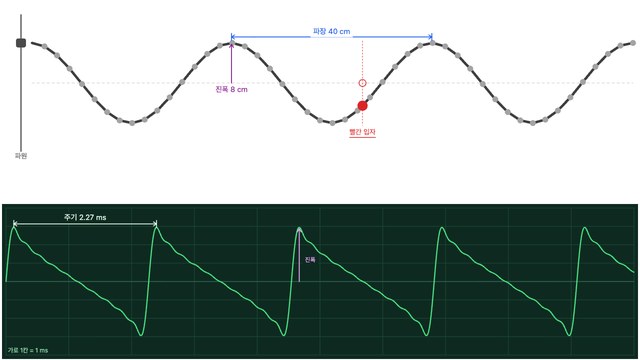 Simulation
Waves and Sound
Watch particles in a rope and in air vibrate in place while a wave passes, then compare amplitude (loudness), frequency (pitch) and waveform (tone color) with an oscilloscope and synthesized sound. A high-school tab shows and plays standing waves on a string and in open and closed pipes, measures the speed of sound with a resonance tube, and demonstrates the Doppler effect of a moving source.
Made with p5.js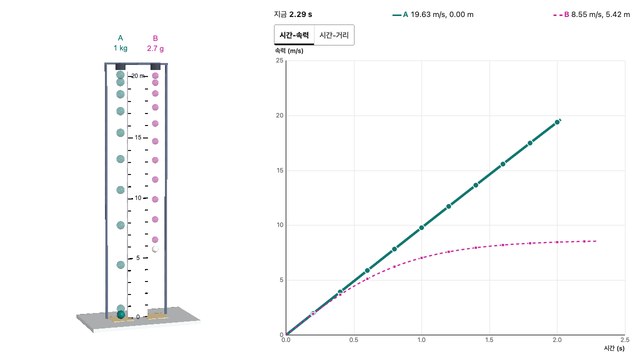 Simulation
Free Fall and Mechanical Energy
Drop two objects that leave strobe images, and use time–speed graphs and a data table to find that they gain 9.8 m/s every second. Energy bars and a roller coaster show mechanical energy changing form and being conserved; with air resistance or friction, the lost mechanical energy becomes heat (high-school extension).
Made with Web VPython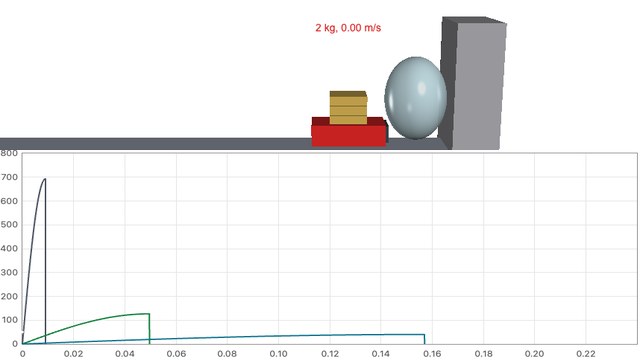 Simulation
Impulse, Safety Devices and Momentum
Stop a cart against a concrete wall, a mat and an airbag at the same speed and compare impulses as areas under force-time graphs. An extension tab collides two carts and checks with a bar chart that total momentum is conserved (links to high-school physics).
Made with Web VPython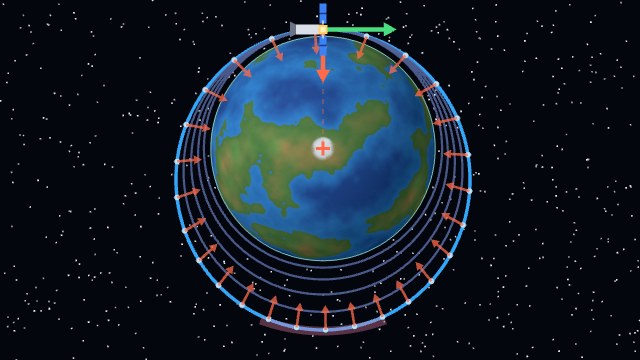 Game
Orbit Mission
A five-mission game: hit villages with Newton's cannon, then fire faster until the ball becomes a satellite. Arrows show that falling and orbiting objects both accelerate toward Earth's center.
Made with three.js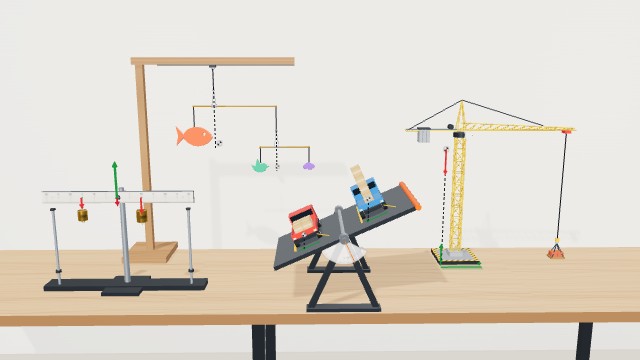 Simulation
Balance Lab
Hang weights on a lever bench, slide the strings of a mobile, and find when blocks, trucks and a crane tip over to explore equilibrium (zero net force and zero net torque) and the stability of structures. The balance point of a mobile turns out to be the internal division point of two masses, on a number line and on a coordinate plane.
Made with three.js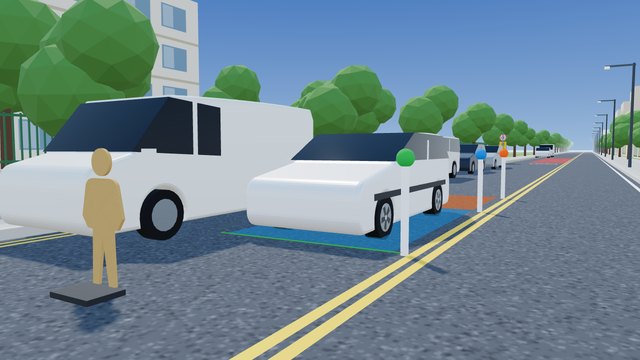 SimulationUpdatedOct 31
School Zone Stopping Distance
From the driver's seat, drive a test car past a school in 3D and press the brake yourself when a cardboard test dummy darts out from behind a parked car, measuring your own reaction time. See how speed, road surface, vehicle mass and phone use change the reaction and braking distances through the area under the v–t graph and a high-speed multiflash photo analysis of uniformly accelerated motion.
Made with three.js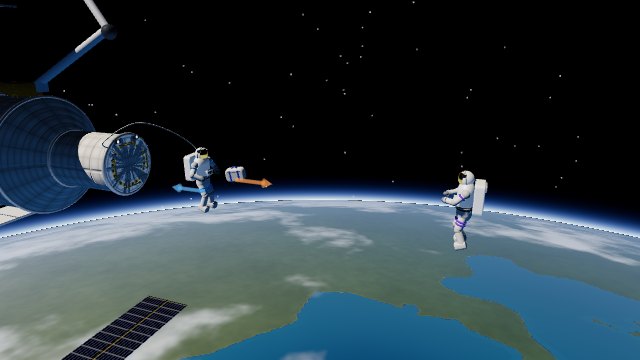 SimulationUpdatedOct 31
Adrift in Space
An astronaut with a snapped tether throws tools to get back to the station. Measure the forces both objects feel during a throw on a force-time graph and the momentum afterward with arrows and bars to see action and reaction and conservation of momentum, then extend it to catching with a crewmate and a fire-extinguisher jet that works like a rocket.
Made with three.js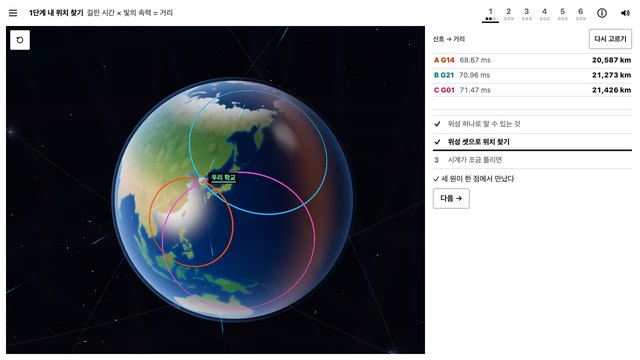 Simulation
Switch Off the GPS Clock Correction
Why are GPS satellite clocks deliberately set ‘wrong’? On a 3-D Earth, find your position from satellite signals and switch the height and speed effects on and off to see the +38.5 μs a day. Then turn the correction off: a simple receiver that trusts a ground clock places you up in the sky, while a real receiver keeps your position but gets the time wrong. Six stages that go on to the equivalence principle, escape velocity and atmospheres, how rockets reach orbit, and black holes.
Made with three.js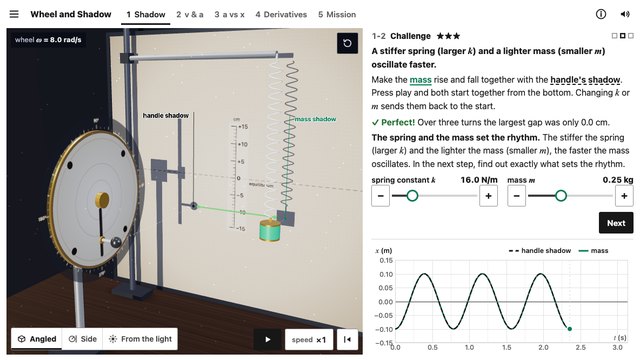 SimulationUpdatedOct 31
Wheel and Shadow: Simple Harmonic Motion
In a dark lab, parallel light casts the handle of a turning wheel onto the wall. Match a mass on a spring to the bobbing shadow to find ω = √(k/m), check velocity, acceleration and a = −ω²x, then use tangent slopes and a radius-1 circle to see why (sin θ)′ = cos θ and how the chain rule works.
Made with three.js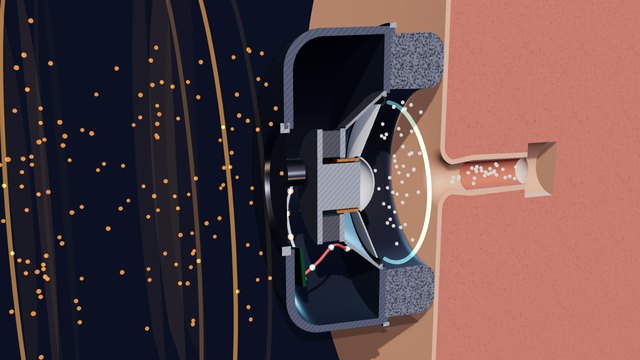 Simulation
Noise-Cancelling Headphones
Inside a noise-cancelling headphone cut in half, match the anti-noise's delay (phase) and size to bring the sound at the ear to zero, then compare kinds of noise, processing delay and ear cushions. In an echo-free room, walk between two speakers to find constructive and destructive interference set by path difference, and quiet one seat with an anti-noise speaker.
Made with three.js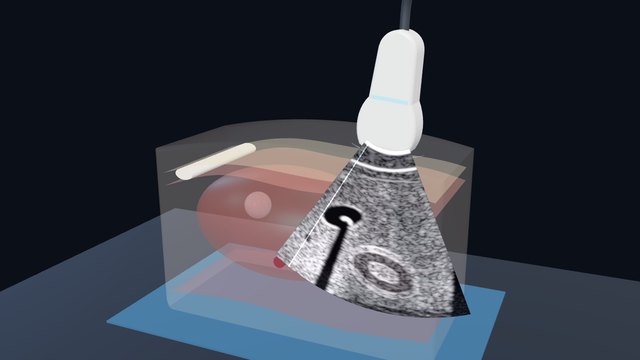 SimulationUpdatedOct 31
Ultrasound Imaging: Drawing the Body with Echoes
A five-stage simulation: see reflection, transmission and phase change at a boundary on a chain of springs, then put a probe on a body phantom, measure depth from echo times (A-mode) and stack lines into a cross-section image (B-mode). It also covers the effects of gel and frequency, and non-destructive testing for a crack inside a rail.
Made with three.js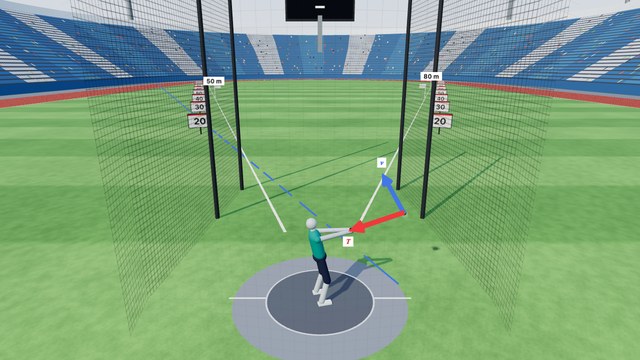 SimulationUpdatedOct 31
Hammer Throw
Whirl a 7.26 kg hammer in a stadium throwing circle and let it go. Predict which way it flies at the moment of release, see how the motion changes when the angle between the wire tension and the velocity is 90°, smaller or larger, then throw past 80 m inside the sector and connect the direction of force with the direction of motion through a flying hammer and a cart on a curve.
Made with three.js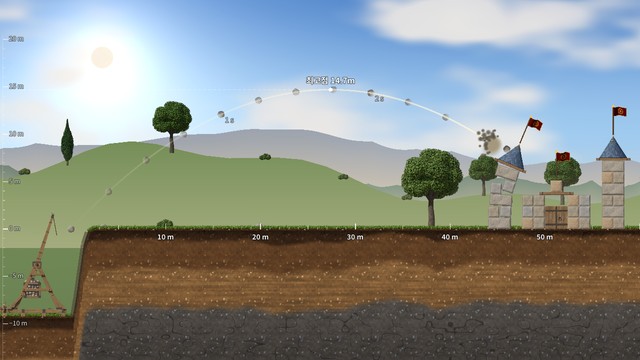 GameUpdatedOct 31
Trebuchet Siege: projectile motion and mechanical energy
A Godot game in which you are a trebuchet engineer: set the angle and speed, predict where the stone will land (or how high it will go) before firing, then check. Faint stones every 0.25 s, horizontal and vertical velocity arrows and kinetic/potential energy bars reveal projectile motion, from a high wall and a deep valley to a practice castle that collapses under a physics engine.
Made with Godot